How to Build a Creative Strategy That Actually Works
Learn how to build a creative strategy that connects business goals, audience insight and big ideas to create work people notice, remember and act on.
Tutorials

Creative strategy sounds like one of those things that should be very complicated.
There are workshops.
Research decks.
Competitive audits.
Audience profiles.
Brand platforms.
Sticky notes.
Possibly a room full of people standing around a wall while someone says, “Let's ideate.”
I have been in enough creative meetings to know that a strategy can become complicated very quickly.
The useful ones usually begin with a much simpler question:
What are we actually trying to accomplish?
A creative strategy gives a creative team a clear understanding of the problem, the audience, the opportunity and the idea that connects them (like this data: What $1.3 Billion in Ad Spend Reveals About Winning Creative in 2026).
It creates a bridge between what a business needs and what people might actually care about.
“The best creative strategies I've worked with have enough structure to keep everyone moving and enough space for a genuinely good idea to surprise you.”
Riel Bo, Creative Director
That balance matters.
A strategy should create clarity without squeezing the life out of the creative process.
It should give people something to solve.
Then it should get out of the way long enough for them to solve it.

What Is a Creative Strategy?
A creative strategy is a framework that guides how a brand communicates with its audience.
It connects several important pieces:
Business objectives
Audience insight
Market context
Brand positioning
Customer motivation
Creative opportunity
Key messages
Creative concept
Desired response
Success measures
The strategy helps answer a series of questions.
What are we trying to accomplish?
Who are we talking to?
What do we know about them?
What problem are we solving?
What should they think, feel or do?
Why should they believe us?
What idea could make the message matter?
These questions sound straightforward.
Getting useful answers takes considerably more work.
That is where the creative strategist earns their coffee.
1. Start With the Business Problem
Before you ask what the campaign should look like, understand why the campaign exists.
A company might say:
That is a request.
It isn't necessarily the problem.
The real problem could be:
Sales are slowing.
A new product isn't getting traction.
Customers don't understand the value proposition.
The brand has become difficult to differentiate.
The company is entering a new market.
The audience has changed.
The business has grown but the brand hasn't caught up.
The creative strategy should begin by finding the actual problem.
Imagine a software company says it needs a new website.
You could immediately start discussing navigation, typography and homepage layouts.
Or you could ask why.
Perhaps visitors arrive at the site but can't understand what the company does.
Perhaps prospects understand the product but don't understand why it is different.
Perhaps the company has five products and no clear story connecting them.
Those are very different problems.
They would produce very different creative strategies.
“I always want to know what we're trying to change before we decide what we're trying to make. Otherwise, you can spend a lot of time producing something beautifully that solves absolutely nothing.”
Riel Bo, Creative Director
A good strategy starts with the problem.
2. Define the Business Objective
Once you understand the problem, define what success needs to look like.
The objective might be:
Increase qualified leads.
Launch a new product.
Grow awareness.
Increase sales.
Enter a new market.
Change brand perception.
Improve customer retention.
Increase adoption.
Build credibility.
Get people to sign up.
The objective needs enough specificity to guide creative decisions.
“Make people aware of us” is difficult to build a strategy around.
“Increase qualified leads from small business owners by 20 percent” gives the team something to work with.
Creative teams need room to think.
They also need a target.
Otherwise, everyone is simply making things and hoping the internet feels something.
3. Get Very Clear About the Audience
This is where many creative strategies become generic.
The audience gets described as:
Women aged 25 to 45.
Or:
Busy professionals.
Or perhaps the particularly adventurous:
Millennials.
Congratulations.
You have described a demographic.
You haven't necessarily described a person.
A useful audience profile digs deeper.
What are they trying to accomplish?
What frustrates them?
What do they already believe?
What are they worried about?
What are they tired of hearing?
What do they value?
What makes them skeptical?
What would make them pay attention?
What would make them trust you?
What would make them tell a friend?
This is where research matters.
Talk to customers.
Read reviews.
Look at support tickets.
Listen to sales calls.
Study search behavior.
Read comments.
Look at competitor conversations.
Pay attention to the language customers actually use.
You may discover that the thing you thought people wanted isn't the thing they are really buying.
That discovery can change the entire creative strategy.
4. Find the Human Insight
An audience fact tells you something about people.
An insight tells you something interesting about why they behave the way they do.
Consider a fitness brand.
An audience fact might be:
Customers want to exercise more.
An insight might be:
Now there is something interesting to work with.
The creative opportunity might become:
Make movement feel achievable instead of another promise people have to keep failing at.
That can influence the tone.
The messaging.
The campaign idea.
The photography.
The product experience.
The entire emotional direction of the brand.
That is the power of a good insight.
It opens a door.
5. Understand the Competition
Creative strategy needs context.
You need to know what other brands are saying and how they are saying it.
Look at:
Positioning
Messaging
Visual identity
Campaign concepts
Customer promises
Tone of voice
Content
Advertising
Social media
Customer reviews
The goal isn't to copy what competitors are doing.
Please don't.
There are already enough websites in the world using the same photograph of a person staring thoughtfully into the middle distance.
The more useful question is:
Where is everyone saying the same thing?
If every competitor says they are:
Innovative.
Customer-focused.
Trusted.
Easy.
Flexible.
Secure.
Leading.
Then those words probably aren't doing much strategic work.
Look for the territory nobody owns.
That is where differentiation starts to become interesting.
6. Define What Makes the Brand Matter
Now we get to positioning.
A brand needs a reason for someone to choose it.
That reason may be functional.
It may be emotional.
Often, it is a combination.
Consider a premium coffee brand.
The functional benefit is coffee.
There are several thousand ways to acquire coffee.
The emotional value could be ritual, identity, taste, discovery or belonging.
The creative strategy needs to understand what the brand can credibly own.
Ask:
What are we genuinely good at?
What do customers value?
What can competitors easily copy?
What is difficult for competitors to copy?
What does the audience wish existed?
What can this brand say with credibility?
The answers begin to define the territory.
7. Decide What You Want People to Think, Feel or Do
A creative strategy needs an intended response.
That response could be:
Think:
“This company understands businesses like mine.”
Feel:
“I finally found something that makes this easier.”
Do:
“I'm going to book a demo.”
Those three things can work together.
A campaign might change how someone thinks about a category.
That change creates an emotional response.
The emotional response makes an action more likely.
The creative strategy should understand the sequence.
Otherwise, you can end up with creative work that gets compliments instead of results.
And compliments, while lovely, are not generally accepted by finance departments as a growth metric.
8. Find the Creative Opportunity
Now you have the ingredients.
The business problem.
The objective.
The audience.
The insight.
The competition.
The brand.
The desired response.
The next question is:
What is the interesting idea hiding in all of this?
This is the part people sometimes try to rush.
Don't.
The creative opportunity is where strategy starts becoming creative.
Imagine you are working with a financial services company.
The category is filled with complicated language.
Fees.
Rates.
Compliance.
Security.
Regulations.
Financial jargon that seems to have been invented specifically to make normal people avoid reading.
Your audience insight reveals that small business owners aren't looking for more financial information.
They want to feel like someone has finally made the system understandable.
The creative opportunity might be:
Make complicated money feel simple.
Now you have territory.
That territory can influence the campaign.
The website.
The content.
The visual system.
The brand voice.
The product experience.
The strategy has started to produce an idea.
9. Build the Big Idea
The big idea is the central creative thought that brings the strategy to life.
It should be:
Relevant
Distinctive
Understandable
Flexible
Ownable
Memorable
Most importantly, it should give the creative team somewhere to go.
A good idea can generate multiple expressions.
A campaign headline.
A video.
A social series.
A website experience.
A billboard.
An email.
A sales presentation.
A product launch.
The idea should be able to travel.
“A good creative idea should make the team slightly nervous and immediately curious. If everyone understands exactly what it will look like before you've made anything, there may not be enough idea in it.”
Riel Bo, Creative Director
That doesn't mean the idea needs to be bizarre.
It means it needs enough tension to be interesting.
10. Turn the Strategy Into Creative Principles
Once you have the big idea, define how it should behave.
These are your creative principles.
For example:
Human over corporate
Use natural language and real situations.
Confident over complicated
Make the brand feel knowledgeable without making the audience feel stupid.
Unexpected over predictable
Look for creative choices that disrupt category conventions.
Useful over noisy
Every piece of content should earn its place.
Consistent over repetitive
The brand should feel connected without becoming visually monotonous.
These principles become useful when the work gets messy.
And creative work always gets messy.
A team can use them to make decisions without asking the creative director to personally approve every headline.
Which is good.
Creative directors enjoy lunch too.
11. Give the Creative Team Something They Can Actually Use
A strategy should eventually become practical.
The team needs to understand:
The objective
The audience
The insight
The positioning
The key message
The creative opportunity
The big idea
The tone
The visual direction
The desired response
The constraints
The measures of success
This doesn't necessarily require a giant deck.
In fact, I have seen beautifully designed strategy presentations that managed to hide the actual strategy somewhere around slide 47.
The best strategy documents are clear.
You should be able to hand one to a creative team and have them understand what problem they are solving.
That is the test.
12. Leave Room for Creative Thinking
A creative strategy should create boundaries.
It shouldn't build a prison.
This is an important distinction.
If the strategy specifies every headline, image, layout, color and animation before the creative team begins, you don't have a strategy.
You have production instructions.
Creative teams need room to explore.
The strategist establishes the territory.
The creative team explores what might exist inside it.
Sometimes the best idea will challenge the original thinking.
That is a good thing.
A creative strategy should be strong enough to guide the work and flexible enough to learn from it.
13. Test the Strategy Before You Produce Everything
Before you spend weeks producing a campaign, ask whether the strategic idea holds up.
Can you explain it simply?
Does the audience actually care?
Does it connect to the business objective?
Does it differentiate the brand?
Can the idea work across channels?
Can the team generate several strong creative executions from it?
Does it feel credible?
Would the audience remember it?
Could a competitor say exactly the same thing?
That last question is particularly useful.
If the answer is yes, keep working.
14. Measure What Matters
Creative strategy needs an understanding of measurement.
The exact metrics depend on the project.
They might include:
Brand awareness
Engagement
Qualified leads
Conversion rate
Sales
Customer acquisition
Website behavior
Content performance
Product adoption
Brand perception
Retention
The mistake is treating every available number as equally important.
A campaign can receive enormous engagement and accomplish very little.
A beautiful website can win design awards and produce terrible conversion rates.
A viral video can generate millions of views from people who have absolutely no interest in buying the product.
Success needs to be connected to the original objective.
Remember the first question?
What are we trying to accomplish?
The measurement should answer it.
15. Build AI Into the Creative Strategy
AI adds another layer to the process.
It can help with research.
It can identify patterns in customer feedback.
It can generate hypotheses.
It can explore audience segments.
It can create creative territories.
It can produce early concepts.
It can analyze content performance.
It can help teams develop variations.
That makes it useful throughout the strategy process.
But AI should support strategic thinking rather than replace it.
A language model can give you 50 possible audience insights in seconds.
The strategist still needs to determine which ones are actually meaningful.
It can generate 100 campaign ideas.
Someone still needs to know which ideas belong to the brand.
It can analyze thousands of customer comments.
Someone still needs to understand what the pattern means.
“AI is incredibly good at helping you explore the territory. You still need a human who knows why you're there.”
Riel Bo, Creative Director
That is increasingly becoming part of the modern creative strategist's job.
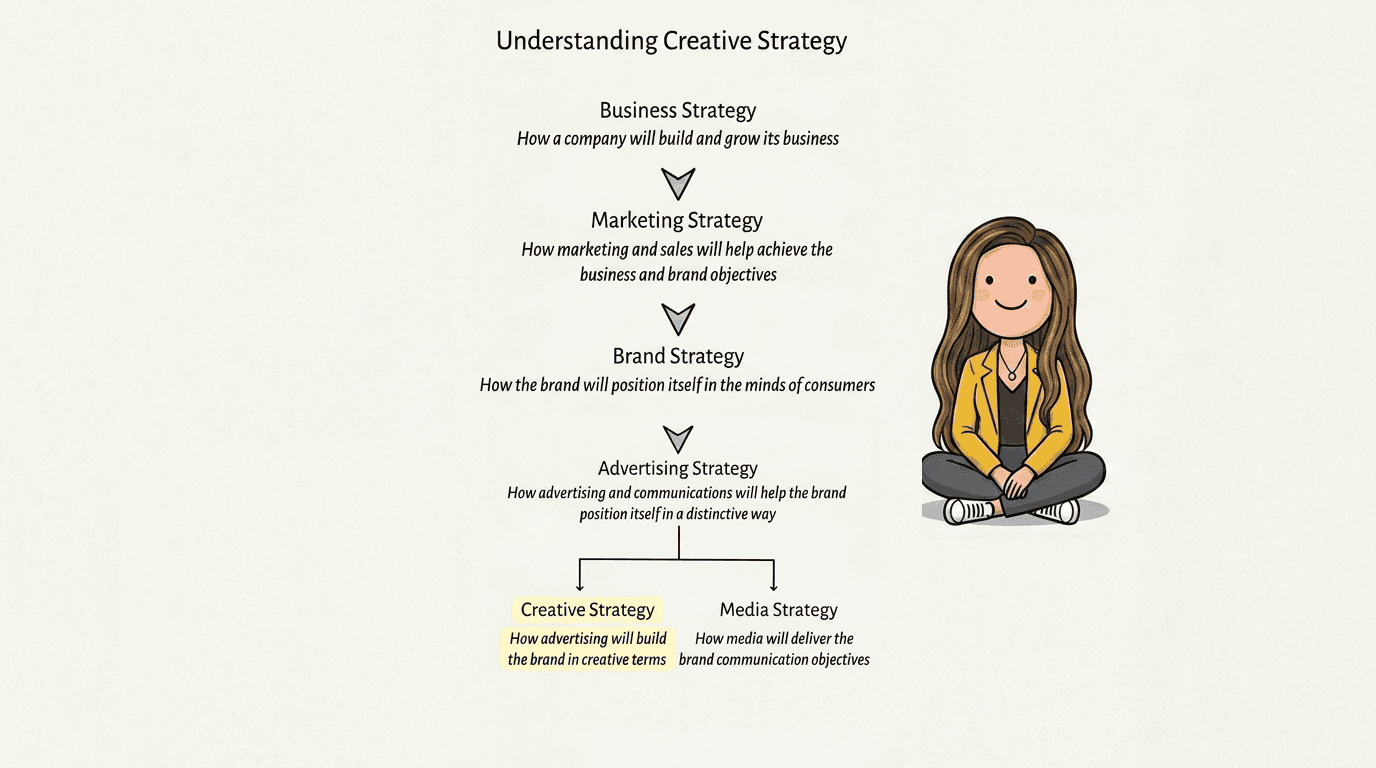
The Creative Strategy Framework I Use
There are many creative strategy frameworks.
I prefer one that keeps the thinking practical.
1. Business
What does the business need?
Define the commercial objective.
2. Audience
Who needs to care?
Understand the person behind the demographic.
3. Problem
What is standing in the way?
Identify the real communication or business challenge.
4. Insight
What do we understand about the audience that creates an opportunity?
Find the human truth.
5. Position
What should this brand own?
Define the territory.
6. Idea
What creative thought can bring the strategy to life?
Find the big idea.
7. Expression
How should people experience it?
Define the creative direction.
8. Measurement
How will we know it worked?
Connect creative output to the original objective.
That is the entire system.
Eight questions.
A considerable amount of thinking.
Far fewer unnecessary meetings.


Common Creative Strategy Mistakes
Even experienced teams make these mistakes.
Starting With the Deliverable
“We need a campaign.”
“We need a website.”
“We need social content.”
“We need a new brand.”
Those are deliverables.
Start with the problem.
Making the Audience Too Generic
If your audience could describe half the population, you probably need to go deeper.
Confusing Information With Insight
Knowing something about your customer doesn't automatically make it an insight.
The insight needs to reveal something useful.
Copying the Category
If everyone is positioning themselves as innovative, calling yourself innovative isn't much of a strategy.
Trying to Say Everything
A strategy needs priorities.
If everything is important, nothing is.
Making the Strategy Too Complicated
The thinking can be sophisticated.
The explanation should still be clear.
Forgetting the Business Objective
Creative strategy exists within a business.
The work should ultimately serve a purpose.
What Does a Good Creative Strategy Look Like?
A good creative strategy creates a moment of recognition.
The team reads it and thinks:
Yes. That's the problem.
Then:
Yes. That's our audience.
Then:
Yes. That's what we've been trying to say.
And finally:
Okay. I know what we can make.
That is the moment you want.
The strategy has done its job.
It has created clarity.
Now the creative team can make something.
Creative Strategy Is a Thinking Discipline
There is a temptation to think of strategy as the serious part of creative work and ideas as the fun part.
I don't see it that way.
Strategy is where you become curious.
You look at the business.
You look at the audience.
You look at the category.
You notice the contradictions.
You ask why.
You ask again.
You discover something.
Then you turn that discovery into an opportunity.
That is creative thinking.
The strategy simply gives it somewhere to land.
“I love the point in a project when everyone stops talking about what we could make and starts talking about what the audience actually needs. That's usually where the interesting idea walks into the room.”
Riel Bo, Creative Director
The best creative strategies don't make creativity smaller.
They make it sharper.
They give the creative team a problem worth solving, an audience worth understanding and an idea worth pursuing.
And once you have those things, the rest of the work gets considerably more interesting.
Frequently Asked Questions
What is a creative strategy?
A creative strategy is a framework that connects business objectives, audience insight, brand positioning and creative ideas. It gives creative teams a clear understanding of what they are trying to accomplish and why.
How do you create a creative strategy?
Start by defining the business objective. Then identify the audience, understand the problem, research customer behavior, find a meaningful insight, establish the brand position, develop a creative idea and define how success will be measured.
What should a creative strategy include?
A creative strategy can include the business objective, target audience, audience insight, competitive context, brand positioning, key messages, creative opportunity, big idea, tone, creative principles, desired audience response and success measures.
What is the difference between creative strategy and marketing strategy?
Marketing strategy typically addresses broader questions around markets, customers, products, channels and business growth. Creative strategy focuses specifically on how creative communication can support those objectives.
Why is creative strategy important?
Creative strategy gives creative work a clear purpose. It helps teams understand the problem they are solving, the audience they are trying to reach and the response they want to create.
What is a creative brief?
A creative brief is a concise document that communicates the strategic information a creative team needs to develop the work. It often includes the objective, audience, problem, insight, message, creative direction and desired response.
Can AI help with creative strategy?
Yes. AI can support research, audience analysis, idea generation, content analysis and creative exploration. Human judgment remains important for evaluating insights, understanding context and deciding which opportunities are strategically valuable.
What makes a creative strategy successful?
A successful creative strategy connects a meaningful business objective with a genuine audience insight and a distinctive creative opportunity. It should give the creative team enough clarity to move forward while leaving enough room for original thinking.
The Short Version
A useful creative strategy answers eight questions:
What does the business need?
Who needs to care?
What problem are we solving?
What do we understand about the audience?
What should the brand own?
What is the big idea?
How should the idea come to life?
How will we know it worked?
Get those answers right and you have something valuable.
You have direction.
You have a reason for the work.
You have an audience in mind.
You have an idea worth exploring.
And, perhaps most importantly, you have a fighting chance of making something people actually remember.

Join me for a coffee...
More to Discover


How to Build a Creative Strategy That Actually Works
Learn how to build a creative strategy that connects business goals, audience insight and big ideas to create work people notice, remember and act on.
Tutorials
Creative strategy sounds like one of those things that should be very complicated.
There are workshops.
Research decks.
Competitive audits.
Audience profiles.
Brand platforms.
Sticky notes.
Possibly a room full of people standing around a wall while someone says, “Let's ideate.”
I have been in enough creative meetings to know that a strategy can become complicated very quickly.
The useful ones usually begin with a much simpler question:
What are we actually trying to accomplish?
A creative strategy gives a creative team a clear understanding of the problem, the audience, the opportunity and the idea that connects them (like this data: What $1.3 Billion in Ad Spend Reveals About Winning Creative in 2026).
It creates a bridge between what a business needs and what people might actually care about.
“The best creative strategies I've worked with have enough structure to keep everyone moving and enough space for a genuinely good idea to surprise you.”
Riel Bo, Creative Director
That balance matters.
A strategy should create clarity without squeezing the life out of the creative process.
It should give people something to solve.
Then it should get out of the way long enough for them to solve it.
What Is a Creative Strategy?
A creative strategy is a framework that guides how a brand communicates with its audience.
It connects several important pieces:
Business objectives
Audience insight
Market context
Brand positioning
Customer motivation
Creative opportunity
Key messages
Creative concept
Desired response
Success measures
The strategy helps answer a series of questions.
What are we trying to accomplish?
Who are we talking to?
What do we know about them?
What problem are we solving?
What should they think, feel or do?
Why should they believe us?
What idea could make the message matter?
These questions sound straightforward.
Getting useful answers takes considerably more work.
That is where the creative strategist earns their coffee.
1. Start With the Business Problem
Before you ask what the campaign should look like, understand why the campaign exists.
A company might say:
That is a request.
It isn't necessarily the problem.
The real problem could be:
Sales are slowing.
A new product isn't getting traction.
Customers don't understand the value proposition.
The brand has become difficult to differentiate.
The company is entering a new market.
The audience has changed.
The business has grown but the brand hasn't caught up.
The creative strategy should begin by finding the actual problem.
Imagine a software company says it needs a new website.
You could immediately start discussing navigation, typography and homepage layouts.
Or you could ask why.
Perhaps visitors arrive at the site but can't understand what the company does.
Perhaps prospects understand the product but don't understand why it is different.
Perhaps the company has five products and no clear story connecting them.
Those are very different problems.
They would produce very different creative strategies.
“I always want to know what we're trying to change before we decide what we're trying to make. Otherwise, you can spend a lot of time producing something beautifully that solves absolutely nothing.”
Riel Bo, Creative Director
A good strategy starts with the problem.
2. Define the Business Objective
Once you understand the problem, define what success needs to look like.
The objective might be:
Increase qualified leads.
Launch a new product.
Grow awareness.
Increase sales.
Enter a new market.
Change brand perception.
Improve customer retention.
Increase adoption.
Build credibility.
Get people to sign up.
The objective needs enough specificity to guide creative decisions.
“Make people aware of us” is difficult to build a strategy around.
“Increase qualified leads from small business owners by 20 percent” gives the team something to work with.
Creative teams need room to think.
They also need a target.
Otherwise, everyone is simply making things and hoping the internet feels something.
3. Get Very Clear About the Audience
This is where many creative strategies become generic.
The audience gets described as:
Women aged 25 to 45.
Or:
Busy professionals.
Or perhaps the particularly adventurous:
Millennials.
Congratulations.
You have described a demographic.
You haven't necessarily described a person.
A useful audience profile digs deeper.
What are they trying to accomplish?
What frustrates them?
What do they already believe?
What are they worried about?
What are they tired of hearing?
What do they value?
What makes them skeptical?
What would make them pay attention?
What would make them trust you?
What would make them tell a friend?
This is where research matters.
Talk to customers.
Read reviews.
Look at support tickets.
Listen to sales calls.
Study search behavior.
Read comments.
Look at competitor conversations.
Pay attention to the language customers actually use.
You may discover that the thing you thought people wanted isn't the thing they are really buying.
That discovery can change the entire creative strategy.
4. Find the Human Insight
An audience fact tells you something about people.
An insight tells you something interesting about why they behave the way they do.
Consider a fitness brand.
An audience fact might be:
Customers want to exercise more.
An insight might be:
Now there is something interesting to work with.
The creative opportunity might become:
Make movement feel achievable instead of another promise people have to keep failing at.
That can influence the tone.
The messaging.
The campaign idea.
The photography.
The product experience.
The entire emotional direction of the brand.
That is the power of a good insight.
It opens a door.
5. Understand the Competition
Creative strategy needs context.
You need to know what other brands are saying and how they are saying it.
Look at:
Positioning
Messaging
Visual identity
Campaign concepts
Customer promises
Tone of voice
Content
Advertising
Social media
Customer reviews
The goal isn't to copy what competitors are doing.
Please don't.
There are already enough websites in the world using the same photograph of a person staring thoughtfully into the middle distance.
The more useful question is:
Where is everyone saying the same thing?
If every competitor says they are:
Innovative.
Customer-focused.
Trusted.
Easy.
Flexible.
Secure.
Leading.
Then those words probably aren't doing much strategic work.
Look for the territory nobody owns.
That is where differentiation starts to become interesting.
6. Define What Makes the Brand Matter
Now we get to positioning.
A brand needs a reason for someone to choose it.
That reason may be functional.
It may be emotional.
Often, it is a combination.
Consider a premium coffee brand.
The functional benefit is coffee.
There are several thousand ways to acquire coffee.
The emotional value could be ritual, identity, taste, discovery or belonging.
The creative strategy needs to understand what the brand can credibly own.
Ask:
What are we genuinely good at?
What do customers value?
What can competitors easily copy?
What is difficult for competitors to copy?
What does the audience wish existed?
What can this brand say with credibility?
The answers begin to define the territory.
7. Decide What You Want People to Think, Feel or Do
A creative strategy needs an intended response.
That response could be:
Think:
“This company understands businesses like mine.”
Feel:
“I finally found something that makes this easier.”
Do:
“I'm going to book a demo.”
Those three things can work together.
A campaign might change how someone thinks about a category.
That change creates an emotional response.
The emotional response makes an action more likely.
The creative strategy should understand the sequence.
Otherwise, you can end up with creative work that gets compliments instead of results.
And compliments, while lovely, are not generally accepted by finance departments as a growth metric.
8. Find the Creative Opportunity
Now you have the ingredients.
The business problem.
The objective.
The audience.
The insight.
The competition.
The brand.
The desired response.
The next question is:
What is the interesting idea hiding in all of this?
This is the part people sometimes try to rush.
Don't.
The creative opportunity is where strategy starts becoming creative.
Imagine you are working with a financial services company.
The category is filled with complicated language.
Fees.
Rates.
Compliance.
Security.
Regulations.
Financial jargon that seems to have been invented specifically to make normal people avoid reading.
Your audience insight reveals that small business owners aren't looking for more financial information.
They want to feel like someone has finally made the system understandable.
The creative opportunity might be:
Make complicated money feel simple.
Now you have territory.
That territory can influence the campaign.
The website.
The content.
The visual system.
The brand voice.
The product experience.
The strategy has started to produce an idea.
9. Build the Big Idea
The big idea is the central creative thought that brings the strategy to life.
It should be:
Relevant
Distinctive
Understandable
Flexible
Ownable
Memorable
Most importantly, it should give the creative team somewhere to go.
A good idea can generate multiple expressions.
A campaign headline.
A video.
A social series.
A website experience.
A billboard.
An email.
A sales presentation.
A product launch.
The idea should be able to travel.
“A good creative idea should make the team slightly nervous and immediately curious. If everyone understands exactly what it will look like before you've made anything, there may not be enough idea in it.”
Riel Bo, Creative Director
That doesn't mean the idea needs to be bizarre.
It means it needs enough tension to be interesting.
10. Turn the Strategy Into Creative Principles
Once you have the big idea, define how it should behave.
These are your creative principles.
For example:
Human over corporate
Use natural language and real situations.
Confident over complicated
Make the brand feel knowledgeable without making the audience feel stupid.
Unexpected over predictable
Look for creative choices that disrupt category conventions.
Useful over noisy
Every piece of content should earn its place.
Consistent over repetitive
The brand should feel connected without becoming visually monotonous.
These principles become useful when the work gets messy.
And creative work always gets messy.
A team can use them to make decisions without asking the creative director to personally approve every headline.
Which is good.
Creative directors enjoy lunch too.
11. Give the Creative Team Something They Can Actually Use
A strategy should eventually become practical.
The team needs to understand:
The objective
The audience
The insight
The positioning
The key message
The creative opportunity
The big idea
The tone
The visual direction
The desired response
The constraints
The measures of success
This doesn't necessarily require a giant deck.
In fact, I have seen beautifully designed strategy presentations that managed to hide the actual strategy somewhere around slide 47.
The best strategy documents are clear.
You should be able to hand one to a creative team and have them understand what problem they are solving.
That is the test.
12. Leave Room for Creative Thinking
A creative strategy should create boundaries.
It shouldn't build a prison.
This is an important distinction.
If the strategy specifies every headline, image, layout, color and animation before the creative team begins, you don't have a strategy.
You have production instructions.
Creative teams need room to explore.
The strategist establishes the territory.
The creative team explores what might exist inside it.
Sometimes the best idea will challenge the original thinking.
That is a good thing.
A creative strategy should be strong enough to guide the work and flexible enough to learn from it.
13. Test the Strategy Before You Produce Everything
Before you spend weeks producing a campaign, ask whether the strategic idea holds up.
Can you explain it simply?
Does the audience actually care?
Does it connect to the business objective?
Does it differentiate the brand?
Can the idea work across channels?
Can the team generate several strong creative executions from it?
Does it feel credible?
Would the audience remember it?
Could a competitor say exactly the same thing?
That last question is particularly useful.
If the answer is yes, keep working.
14. Measure What Matters
Creative strategy needs an understanding of measurement.
The exact metrics depend on the project.
They might include:
Brand awareness
Engagement
Qualified leads
Conversion rate
Sales
Customer acquisition
Website behavior
Content performance
Product adoption
Brand perception
Retention
The mistake is treating every available number as equally important.
A campaign can receive enormous engagement and accomplish very little.
A beautiful website can win design awards and produce terrible conversion rates.
A viral video can generate millions of views from people who have absolutely no interest in buying the product.
Success needs to be connected to the original objective.
Remember the first question?
What are we trying to accomplish?
The measurement should answer it.
15. Build AI Into the Creative Strategy
AI adds another layer to the process.
It can help with research.
It can identify patterns in customer feedback.
It can generate hypotheses.
It can explore audience segments.
It can create creative territories.
It can produce early concepts.
It can analyze content performance.
It can help teams develop variations.
That makes it useful throughout the strategy process.
But AI should support strategic thinking rather than replace it.
A language model can give you 50 possible audience insights in seconds.
The strategist still needs to determine which ones are actually meaningful.
It can generate 100 campaign ideas.
Someone still needs to know which ideas belong to the brand.
It can analyze thousands of customer comments.
Someone still needs to understand what the pattern means.
“AI is incredibly good at helping you explore the territory. You still need a human who knows why you're there.”
Riel Bo, Creative Director
That is increasingly becoming part of the modern creative strategist's job.
The Creative Strategy Framework I Use
There are many creative strategy frameworks.
I prefer one that keeps the thinking practical.
1. Business
What does the business need?
Define the commercial objective.
2. Audience
Who needs to care?
Understand the person behind the demographic.
3. Problem
What is standing in the way?
Identify the real communication or business challenge.
4. Insight
What do we understand about the audience that creates an opportunity?
Find the human truth.
5. Position
What should this brand own?
Define the territory.
6. Idea
What creative thought can bring the strategy to life?
Find the big idea.
7. Expression
How should people experience it?
Define the creative direction.
8. Measurement
How will we know it worked?
Connect creative output to the original objective.
That is the entire system.
Eight questions.
A considerable amount of thinking.
Far fewer unnecessary meetings.
Common Creative Strategy Mistakes
Even experienced teams make these mistakes.
Starting With the Deliverable
“We need a campaign.”
“We need a website.”
“We need social content.”
“We need a new brand.”
Those are deliverables.
Start with the problem.
Making the Audience Too Generic
If your audience could describe half the population, you probably need to go deeper.
Confusing Information With Insight
Knowing something about your customer doesn't automatically make it an insight.
The insight needs to reveal something useful.
Copying the Category
If everyone is positioning themselves as innovative, calling yourself innovative isn't much of a strategy.
Trying to Say Everything
A strategy needs priorities.
If everything is important, nothing is.
Making the Strategy Too Complicated
The thinking can be sophisticated.
The explanation should still be clear.
Forgetting the Business Objective
Creative strategy exists within a business.
The work should ultimately serve a purpose.
What Does a Good Creative Strategy Look Like?
A good creative strategy creates a moment of recognition.
The team reads it and thinks:
Yes. That's the problem.
Then:
Yes. That's our audience.
Then:
Yes. That's what we've been trying to say.
And finally:
Okay. I know what we can make.
That is the moment you want.
The strategy has done its job.
It has created clarity.
Now the creative team can make something.
Creative Strategy Is a Thinking Discipline
There is a temptation to think of strategy as the serious part of creative work and ideas as the fun part.
I don't see it that way.
Strategy is where you become curious.
You look at the business.
You look at the audience.
You look at the category.
You notice the contradictions.
You ask why.
You ask again.
You discover something.
Then you turn that discovery into an opportunity.
That is creative thinking.
The strategy simply gives it somewhere to land.
“I love the point in a project when everyone stops talking about what we could make and starts talking about what the audience actually needs. That's usually where the interesting idea walks into the room.”
Riel Bo, Creative Director
The best creative strategies don't make creativity smaller.
They make it sharper.
They give the creative team a problem worth solving, an audience worth understanding and an idea worth pursuing.
And once you have those things, the rest of the work gets considerably more interesting.
Frequently Asked Questions
What is a creative strategy?
A creative strategy is a framework that connects business objectives, audience insight, brand positioning and creative ideas. It gives creative teams a clear understanding of what they are trying to accomplish and why.
How do you create a creative strategy?
Start by defining the business objective. Then identify the audience, understand the problem, research customer behavior, find a meaningful insight, establish the brand position, develop a creative idea and define how success will be measured.
What should a creative strategy include?
A creative strategy can include the business objective, target audience, audience insight, competitive context, brand positioning, key messages, creative opportunity, big idea, tone, creative principles, desired audience response and success measures.
What is the difference between creative strategy and marketing strategy?
Marketing strategy typically addresses broader questions around markets, customers, products, channels and business growth. Creative strategy focuses specifically on how creative communication can support those objectives.
Why is creative strategy important?
Creative strategy gives creative work a clear purpose. It helps teams understand the problem they are solving, the audience they are trying to reach and the response they want to create.
What is a creative brief?
A creative brief is a concise document that communicates the strategic information a creative team needs to develop the work. It often includes the objective, audience, problem, insight, message, creative direction and desired response.
Can AI help with creative strategy?
Yes. AI can support research, audience analysis, idea generation, content analysis and creative exploration. Human judgment remains important for evaluating insights, understanding context and deciding which opportunities are strategically valuable.
What makes a creative strategy successful?
A successful creative strategy connects a meaningful business objective with a genuine audience insight and a distinctive creative opportunity. It should give the creative team enough clarity to move forward while leaving enough room for original thinking.
The Short Version
A useful creative strategy answers eight questions:
What does the business need?
Who needs to care?
What problem are we solving?
What do we understand about the audience?
What should the brand own?
What is the big idea?
How should the idea come to life?
How will we know it worked?
Get those answers right and you have something valuable.
You have direction.
You have a reason for the work.
You have an audience in mind.
You have an idea worth exploring.
And, perhaps most importantly, you have a fighting chance of making something people actually remember.
Join me for a coffee...
More to Discover
How to Build a Creative Strategy That Actually Works
Learn how to build a creative strategy that connects business goals, audience insight and big ideas to create work people notice, remember and act on.
Tutorials
Creative strategy sounds like one of those things that should be very complicated.
There are workshops.
Research decks.
Competitive audits.
Audience profiles.
Brand platforms.
Sticky notes.
Possibly a room full of people standing around a wall while someone says, “Let's ideate.”
I have been in enough creative meetings to know that a strategy can become complicated very quickly.
The useful ones usually begin with a much simpler question:
What are we actually trying to accomplish?
A creative strategy gives a creative team a clear understanding of the problem, the audience, the opportunity and the idea that connects them (like this data: What $1.3 Billion in Ad Spend Reveals About Winning Creative in 2026).
It creates a bridge between what a business needs and what people might actually care about.
“The best creative strategies I've worked with have enough structure to keep everyone moving and enough space for a genuinely good idea to surprise you.”
Riel Bo, Creative Director
That balance matters.
A strategy should create clarity without squeezing the life out of the creative process.
It should give people something to solve.
Then it should get out of the way long enough for them to solve it.
What Is a Creative Strategy?
A creative strategy is a framework that guides how a brand communicates with its audience.
It connects several important pieces:
Business objectives
Audience insight
Market context
Brand positioning
Customer motivation
Creative opportunity
Key messages
Creative concept
Desired response
Success measures
The strategy helps answer a series of questions.
What are we trying to accomplish?
Who are we talking to?
What do we know about them?
What problem are we solving?
What should they think, feel or do?
Why should they believe us?
What idea could make the message matter?
These questions sound straightforward.
Getting useful answers takes considerably more work.
That is where the creative strategist earns their coffee.
1. Start With the Business Problem
Before you ask what the campaign should look like, understand why the campaign exists.
A company might say:
That is a request.
It isn't necessarily the problem.
The real problem could be:
Sales are slowing.
A new product isn't getting traction.
Customers don't understand the value proposition.
The brand has become difficult to differentiate.
The company is entering a new market.
The audience has changed.
The business has grown but the brand hasn't caught up.
The creative strategy should begin by finding the actual problem.
Imagine a software company says it needs a new website.
You could immediately start discussing navigation, typography and homepage layouts.
Or you could ask why.
Perhaps visitors arrive at the site but can't understand what the company does.
Perhaps prospects understand the product but don't understand why it is different.
Perhaps the company has five products and no clear story connecting them.
Those are very different problems.
They would produce very different creative strategies.
“I always want to know what we're trying to change before we decide what we're trying to make. Otherwise, you can spend a lot of time producing something beautifully that solves absolutely nothing.”
Riel Bo, Creative Director
A good strategy starts with the problem.
2. Define the Business Objective
Once you understand the problem, define what success needs to look like.
The objective might be:
Increase qualified leads.
Launch a new product.
Grow awareness.
Increase sales.
Enter a new market.
Change brand perception.
Improve customer retention.
Increase adoption.
Build credibility.
Get people to sign up.
The objective needs enough specificity to guide creative decisions.
“Make people aware of us” is difficult to build a strategy around.
“Increase qualified leads from small business owners by 20 percent” gives the team something to work with.
Creative teams need room to think.
They also need a target.
Otherwise, everyone is simply making things and hoping the internet feels something.
3. Get Very Clear About the Audience
This is where many creative strategies become generic.
The audience gets described as:
Women aged 25 to 45.
Or:
Busy professionals.
Or perhaps the particularly adventurous:
Millennials.
Congratulations.
You have described a demographic.
You haven't necessarily described a person.
A useful audience profile digs deeper.
What are they trying to accomplish?
What frustrates them?
What do they already believe?
What are they worried about?
What are they tired of hearing?
What do they value?
What makes them skeptical?
What would make them pay attention?
What would make them trust you?
What would make them tell a friend?
This is where research matters.
Talk to customers.
Read reviews.
Look at support tickets.
Listen to sales calls.
Study search behavior.
Read comments.
Look at competitor conversations.
Pay attention to the language customers actually use.
You may discover that the thing you thought people wanted isn't the thing they are really buying.
That discovery can change the entire creative strategy.
4. Find the Human Insight
An audience fact tells you something about people.
An insight tells you something interesting about why they behave the way they do.
Consider a fitness brand.
An audience fact might be:
Customers want to exercise more.
An insight might be:
Now there is something interesting to work with.
The creative opportunity might become:
Make movement feel achievable instead of another promise people have to keep failing at.
That can influence the tone.
The messaging.
The campaign idea.
The photography.
The product experience.
The entire emotional direction of the brand.
That is the power of a good insight.
It opens a door.
5. Understand the Competition
Creative strategy needs context.
You need to know what other brands are saying and how they are saying it.
Look at:
Positioning
Messaging
Visual identity
Campaign concepts
Customer promises
Tone of voice
Content
Advertising
Social media
Customer reviews
The goal isn't to copy what competitors are doing.
Please don't.
There are already enough websites in the world using the same photograph of a person staring thoughtfully into the middle distance.
The more useful question is:
Where is everyone saying the same thing?
If every competitor says they are:
Innovative.
Customer-focused.
Trusted.
Easy.
Flexible.
Secure.
Leading.
Then those words probably aren't doing much strategic work.
Look for the territory nobody owns.
That is where differentiation starts to become interesting.
6. Define What Makes the Brand Matter
Now we get to positioning.
A brand needs a reason for someone to choose it.
That reason may be functional.
It may be emotional.
Often, it is a combination.
Consider a premium coffee brand.
The functional benefit is coffee.
There are several thousand ways to acquire coffee.
The emotional value could be ritual, identity, taste, discovery or belonging.
The creative strategy needs to understand what the brand can credibly own.
Ask:
What are we genuinely good at?
What do customers value?
What can competitors easily copy?
What is difficult for competitors to copy?
What does the audience wish existed?
What can this brand say with credibility?
The answers begin to define the territory.
7. Decide What You Want People to Think, Feel or Do
A creative strategy needs an intended response.
That response could be:
Think:
“This company understands businesses like mine.”
Feel:
“I finally found something that makes this easier.”
Do:
“I'm going to book a demo.”
Those three things can work together.
A campaign might change how someone thinks about a category.
That change creates an emotional response.
The emotional response makes an action more likely.
The creative strategy should understand the sequence.
Otherwise, you can end up with creative work that gets compliments instead of results.
And compliments, while lovely, are not generally accepted by finance departments as a growth metric.
8. Find the Creative Opportunity
Now you have the ingredients.
The business problem.
The objective.
The audience.
The insight.
The competition.
The brand.
The desired response.
The next question is:
What is the interesting idea hiding in all of this?
This is the part people sometimes try to rush.
Don't.
The creative opportunity is where strategy starts becoming creative.
Imagine you are working with a financial services company.
The category is filled with complicated language.
Fees.
Rates.
Compliance.
Security.
Regulations.
Financial jargon that seems to have been invented specifically to make normal people avoid reading.
Your audience insight reveals that small business owners aren't looking for more financial information.
They want to feel like someone has finally made the system understandable.
The creative opportunity might be:
Make complicated money feel simple.
Now you have territory.
That territory can influence the campaign.
The website.
The content.
The visual system.
The brand voice.
The product experience.
The strategy has started to produce an idea.
9. Build the Big Idea
The big idea is the central creative thought that brings the strategy to life.
It should be:
Relevant
Distinctive
Understandable
Flexible
Ownable
Memorable
Most importantly, it should give the creative team somewhere to go.
A good idea can generate multiple expressions.
A campaign headline.
A video.
A social series.
A website experience.
A billboard.
An email.
A sales presentation.
A product launch.
The idea should be able to travel.
“A good creative idea should make the team slightly nervous and immediately curious. If everyone understands exactly what it will look like before you've made anything, there may not be enough idea in it.”
Riel Bo, Creative Director
That doesn't mean the idea needs to be bizarre.
It means it needs enough tension to be interesting.
10. Turn the Strategy Into Creative Principles
Once you have the big idea, define how it should behave.
These are your creative principles.
For example:
Human over corporate
Use natural language and real situations.
Confident over complicated
Make the brand feel knowledgeable without making the audience feel stupid.
Unexpected over predictable
Look for creative choices that disrupt category conventions.
Useful over noisy
Every piece of content should earn its place.
Consistent over repetitive
The brand should feel connected without becoming visually monotonous.
These principles become useful when the work gets messy.
And creative work always gets messy.
A team can use them to make decisions without asking the creative director to personally approve every headline.
Which is good.
Creative directors enjoy lunch too.
11. Give the Creative Team Something They Can Actually Use
A strategy should eventually become practical.
The team needs to understand:
The objective
The audience
The insight
The positioning
The key message
The creative opportunity
The big idea
The tone
The visual direction
The desired response
The constraints
The measures of success
This doesn't necessarily require a giant deck.
In fact, I have seen beautifully designed strategy presentations that managed to hide the actual strategy somewhere around slide 47.
The best strategy documents are clear.
You should be able to hand one to a creative team and have them understand what problem they are solving.
That is the test.
12. Leave Room for Creative Thinking
A creative strategy should create boundaries.
It shouldn't build a prison.
This is an important distinction.
If the strategy specifies every headline, image, layout, color and animation before the creative team begins, you don't have a strategy.
You have production instructions.
Creative teams need room to explore.
The strategist establishes the territory.
The creative team explores what might exist inside it.
Sometimes the best idea will challenge the original thinking.
That is a good thing.
A creative strategy should be strong enough to guide the work and flexible enough to learn from it.
13. Test the Strategy Before You Produce Everything
Before you spend weeks producing a campaign, ask whether the strategic idea holds up.
Can you explain it simply?
Does the audience actually care?
Does it connect to the business objective?
Does it differentiate the brand?
Can the idea work across channels?
Can the team generate several strong creative executions from it?
Does it feel credible?
Would the audience remember it?
Could a competitor say exactly the same thing?
That last question is particularly useful.
If the answer is yes, keep working.
14. Measure What Matters
Creative strategy needs an understanding of measurement.
The exact metrics depend on the project.
They might include:
Brand awareness
Engagement
Qualified leads
Conversion rate
Sales
Customer acquisition
Website behavior
Content performance
Product adoption
Brand perception
Retention
The mistake is treating every available number as equally important.
A campaign can receive enormous engagement and accomplish very little.
A beautiful website can win design awards and produce terrible conversion rates.
A viral video can generate millions of views from people who have absolutely no interest in buying the product.
Success needs to be connected to the original objective.
Remember the first question?
What are we trying to accomplish?
The measurement should answer it.
15. Build AI Into the Creative Strategy
AI adds another layer to the process.
It can help with research.
It can identify patterns in customer feedback.
It can generate hypotheses.
It can explore audience segments.
It can create creative territories.
It can produce early concepts.
It can analyze content performance.
It can help teams develop variations.
That makes it useful throughout the strategy process.
But AI should support strategic thinking rather than replace it.
A language model can give you 50 possible audience insights in seconds.
The strategist still needs to determine which ones are actually meaningful.
It can generate 100 campaign ideas.
Someone still needs to know which ideas belong to the brand.
It can analyze thousands of customer comments.
Someone still needs to understand what the pattern means.
“AI is incredibly good at helping you explore the territory. You still need a human who knows why you're there.”
Riel Bo, Creative Director
That is increasingly becoming part of the modern creative strategist's job.
The Creative Strategy Framework I Use
There are many creative strategy frameworks.
I prefer one that keeps the thinking practical.
1. Business
What does the business need?
Define the commercial objective.
2. Audience
Who needs to care?
Understand the person behind the demographic.
3. Problem
What is standing in the way?
Identify the real communication or business challenge.
4. Insight
What do we understand about the audience that creates an opportunity?
Find the human truth.
5. Position
What should this brand own?
Define the territory.
6. Idea
What creative thought can bring the strategy to life?
Find the big idea.
7. Expression
How should people experience it?
Define the creative direction.
8. Measurement
How will we know it worked?
Connect creative output to the original objective.
That is the entire system.
Eight questions.
A considerable amount of thinking.
Far fewer unnecessary meetings.
Common Creative Strategy Mistakes
Even experienced teams make these mistakes.
Starting With the Deliverable
“We need a campaign.”
“We need a website.”
“We need social content.”
“We need a new brand.”
Those are deliverables.
Start with the problem.
Making the Audience Too Generic
If your audience could describe half the population, you probably need to go deeper.
Confusing Information With Insight
Knowing something about your customer doesn't automatically make it an insight.
The insight needs to reveal something useful.
Copying the Category
If everyone is positioning themselves as innovative, calling yourself innovative isn't much of a strategy.
Trying to Say Everything
A strategy needs priorities.
If everything is important, nothing is.
Making the Strategy Too Complicated
The thinking can be sophisticated.
The explanation should still be clear.
Forgetting the Business Objective
Creative strategy exists within a business.
The work should ultimately serve a purpose.
What Does a Good Creative Strategy Look Like?
A good creative strategy creates a moment of recognition.
The team reads it and thinks:
Yes. That's the problem.
Then:
Yes. That's our audience.
Then:
Yes. That's what we've been trying to say.
And finally:
Okay. I know what we can make.
That is the moment you want.
The strategy has done its job.
It has created clarity.
Now the creative team can make something.
Creative Strategy Is a Thinking Discipline
There is a temptation to think of strategy as the serious part of creative work and ideas as the fun part.
I don't see it that way.
Strategy is where you become curious.
You look at the business.
You look at the audience.
You look at the category.
You notice the contradictions.
You ask why.
You ask again.
You discover something.
Then you turn that discovery into an opportunity.
That is creative thinking.
The strategy simply gives it somewhere to land.
“I love the point in a project when everyone stops talking about what we could make and starts talking about what the audience actually needs. That's usually where the interesting idea walks into the room.”
Riel Bo, Creative Director
The best creative strategies don't make creativity smaller.
They make it sharper.
They give the creative team a problem worth solving, an audience worth understanding and an idea worth pursuing.
And once you have those things, the rest of the work gets considerably more interesting.
Frequently Asked Questions
What is a creative strategy?
A creative strategy is a framework that connects business objectives, audience insight, brand positioning and creative ideas. It gives creative teams a clear understanding of what they are trying to accomplish and why.
How do you create a creative strategy?
Start by defining the business objective. Then identify the audience, understand the problem, research customer behavior, find a meaningful insight, establish the brand position, develop a creative idea and define how success will be measured.
What should a creative strategy include?
A creative strategy can include the business objective, target audience, audience insight, competitive context, brand positioning, key messages, creative opportunity, big idea, tone, creative principles, desired audience response and success measures.
What is the difference between creative strategy and marketing strategy?
Marketing strategy typically addresses broader questions around markets, customers, products, channels and business growth. Creative strategy focuses specifically on how creative communication can support those objectives.
Why is creative strategy important?
Creative strategy gives creative work a clear purpose. It helps teams understand the problem they are solving, the audience they are trying to reach and the response they want to create.
What is a creative brief?
A creative brief is a concise document that communicates the strategic information a creative team needs to develop the work. It often includes the objective, audience, problem, insight, message, creative direction and desired response.
Can AI help with creative strategy?
Yes. AI can support research, audience analysis, idea generation, content analysis and creative exploration. Human judgment remains important for evaluating insights, understanding context and deciding which opportunities are strategically valuable.
What makes a creative strategy successful?
A successful creative strategy connects a meaningful business objective with a genuine audience insight and a distinctive creative opportunity. It should give the creative team enough clarity to move forward while leaving enough room for original thinking.
The Short Version
A useful creative strategy answers eight questions:
What does the business need?
Who needs to care?
What problem are we solving?
What do we understand about the audience?
What should the brand own?
What is the big idea?
How should the idea come to life?
How will we know it worked?
Get those answers right and you have something valuable.
You have direction.
You have a reason for the work.
You have an audience in mind.
You have an idea worth exploring.
And, perhaps most importantly, you have a fighting chance of making something people actually remember.