What Does a Creative Director Actually Do
Learn how creative directors shape strategy, lead teams, build brands and turn business goals into creative work.
Insights

People have a funny idea of what a creative director does.
They picture someone walking into a meeting, looking at a mood board and saying, “Make the logo bigger.”
That is certainly part of the mythology.
The actual job is considerably more interesting.
A creative director sets the creative vision for a brand, campaign or organization and makes sure the work supports a larger business goal. They connect strategy with creative execution, lead creative teams, make decisions, develop ideas and protect the quality of the final work.
In practical terms, a creative director is responsible for answering a deceptively difficult question:
What should we make, why should we make it and how do we make sure it matters?
“The best creative direction sits somewhere between imagination and accountability. You need enough imagination to make people care and enough accountability to make sure the work actually does something.”
Riel Bo, Creative Director
That balance is the interesting part.
A creative director isn't simply the person with the strongest opinions about fonts. Although, to be fair, there are moments when strong opinions about fonts are completely justified.

What Does a Creative Director Do?
A creative director typically oversees the creative vision, strategy, execution and quality of a project or brand.
Their responsibilities can include:
Developing creative concepts
Defining brand direction
Translating business goals into creative ideas
Leading designers, writers, photographers, developers and other creative professionals
Reviewing and improving creative work
Presenting ideas to clients and executives
Establishing visual and verbal direction
Managing creative processes
Making creative decisions
Maintaining brand consistency
Connecting creative work to marketing goals
Building creative teams and workflows
Using emerging technology such as AI to improve creative production
The exact job changes depending on the organization.
A creative director at an advertising agency may spend much of their time developing campaigns. A creative director at a technology company may focus on brand, product experiences and content. A freelance creative director might do all of the above before making dinner.
The title changes.
The fundamental responsibility stays remarkably consistent:
Give the creative work a clear direction.

The Creative Director Is the Bridge Between Strategy and Execution
This is where the role gets interesting.
Businesses tend to have goals.
Creative teams work with ideas.
A creative director connects those two worlds.
Imagine a company launching a new financial product.
The business goal might be:
Increase adoption among small business owners.
The marketing team might identify the audience and develop the positioning.
The creative director then asks:
What should this feel like?
Maybe the category is usually cold, complicated and painfully corporate. The opportunity could be to make financial technology feel human, confident and surprisingly simple.
That decision influences everything that follows.
The campaign idea.
The photography.
The typography.
The website.
The advertising.
The language.
The motion design.
The social content.
Suddenly, a creative direction exists.
That is the job.
“Creative direction is often the moment where a business problem becomes a creative opportunity. That's one of my favorite parts of the work.”
Riel Bo, Creative Director
1. Creative Directors Set the Vision
Every good creative project needs a point of view.
Without one, you get a collection of things.
A logo over here.
A website over there.
Some social graphics.
A campaign headline that someone really likes.
A presentation with 46 slides explaining the thinking behind the campaign headline.
None of these things necessarily add up to an idea.
The creative director establishes the larger vision.
That might include:
The creative concept
The visual language
The tone of voice
The emotional response
The audience experience
The brand personality
The campaign direction
The overall quality standard
The vision gives everyone something to work toward.
It also gives everyone something to reject.
That second part is important.
Creative direction isn't just deciding what belongs.
It is deciding what doesn't.
2. Creative Directors Turn Strategy Into Ideas
Strategy can tell you where you need to go.
Creative direction figures out what the journey looks like.
A strategic document might say:
We need to position the company as the easiest platform for growing businesses.
Useful.
A creative director starts asking different questions.
What does “easy” look like?
What does it sound like?
What would make someone believe it?
What could the brand do that competitors aren't doing?
What idea could communicate that benefit in two seconds?
This is where creative thinking becomes commercially useful.
A good creative director knows that an interesting idea is only the beginning.
The idea needs somewhere to go.
3. Creative Directors Lead Creative Teams
Creative directors rarely make every piece of the work themselves.
They lead the people who do.
Depending on the project, that team might include:
Art directors
Designers
Copywriters
Strategists
Developers
Photographers
Videographers
Motion designers
UX designers
Content creators
Production teams
AI specialists
The creative director creates the conditions for those people to do excellent work.
That requires more than giving instructions.
It requires knowing when to push.
Knowing when to step back.
Knowing when an idea needs another round.
Knowing when an idea has already been through enough rounds and everyone should probably go home.
4. Creative Directors Give Creative Feedback
This is one of the most important skills in the job.
And one of the easiest to underestimate.
“Make it better” is not creative direction.
Neither is:
“I don't like it.”
Useful feedback explains why something isn't working and gives the team a clearer path forward.
A creative director might say:
“The concept is strong but the execution feels too polished for the audience. We need some tension here. Right now it looks like a company trying very hard to look trustworthy. I want it to feel like a company that already is.”
That gives a designer something to work with.
Creative feedback should create clarity.
It shouldn't create emotional damage.
Although some designers will tell you there is a fine line.
5. Creative Directors Protect the Brand
A brand can be beautifully designed and still become a mess.
One campaign feels playful.
The website feels serious.
The sales deck sounds like a law firm.
The social media account suddenly starts talking like a teenager who has discovered five new slang words.
Someone needs to maintain the larger picture.
That person is often the creative director.
They protect the consistency of:
Visual identity
Brand voice
Creative concepts
Customer experience
Campaign expression
Content
Marketing materials
Consistency doesn't mean making everything look identical.
It means making everything feel like it belongs to the same organization.
6. Creative Directors Present and Sell Ideas
Creative directors need to communicate.
A brilliant idea that nobody understands is a very expensive secret.
Creative directors regularly present concepts to:
Clients
CEOs
Marketing leaders
Founders
Boards
Internal stakeholders
Creative teams
That means explaining creative work in language that makes sense to the audience in the room.
A designer might care about composition.
A CMO might care about differentiation.
A CEO might care about growth.
A customer might care about whether the product solves their problem.
The creative director needs to connect those perspectives.
“You should be able to explain a creative idea to a designer at 10 a.m. and a CFO at 2 p.m. without changing what the idea actually means.”
Riel Bo, Creative Director
That is a useful superpower.
7. Creative Directors Make Decisions
There is a lot of ambiguity in creative work.
Everyone has an opinion.
Everyone knows someone who would do it differently.
Someone's brother has a marketing degree.
Someone else once took a Photoshop class.
Eventually somebody has to decide.
Creative directors make those decisions.
They evaluate the work against the strategy, the audience, the brand and the business objective.
That requires judgment.
And judgment is one of the things that becomes more valuable as creative tools become more powerful.
Which brings us to AI.
8. AI Is Changing the Creative Director Role
Creative directors now have access to tools that can generate copy, images, video, concepts, layouts, research and variations in seconds.
That changes the production process dramatically.
It also changes the creative director's job.
When production becomes faster, direction becomes more important.
You can generate 100 ideas very quickly.
The difficult question is still:
Which one is worth pursuing?
AI can help explore possibilities.
It can help with research.
It can create variations.
It can accelerate production.
It can even challenge a creative concept.
But someone still needs to understand the brand, the audience, the business and the cultural context well enough to make the call.
“AI has made the question ‘Can we make it?’ much less interesting. The better question is ‘Should we make it?’”
Riel Bo, Creative Director
That distinction is going to shape the next generation of creative leadership.
The creative director of the future may spend less time managing individual production tasks and more time orchestrating people, technology, ideas and systems.


Creative Director vs. Art Director
These roles overlap, which is why people often confuse them.
An art director generally focuses on the visual execution of a project. They may establish the visual style, direct designers and oversee how a concept is expressed visually.
A creative director typically operates at a broader level.
They may oversee:
Creative strategy
Brand direction
Campaign concepts
Art direction
Copy direction
Creative teams
Client relationships
Production
Overall creative quality
There are plenty of organizations where the titles overlap.
Job titles are notoriously creative themselves.
The important distinction is scope.
Art direction is often concerned with how an idea looks.
Creative direction considers the idea, the reason behind it and how the entire creative system supports the larger objective.
What Skills Does a Creative Director Need?
There is no single degree or career path that turns someone into a creative director.
The role usually develops through years of creative and strategic experience.
The strongest creative directors tend to develop several overlapping skills.
Creative Thinking
You need to generate ideas.
More importantly, you need to recognize good ideas.
Those are different skills.
Strategic Thinking
Creative work needs context.
You should understand the business problem, the audience and the competitive landscape.
Communication
You need to explain ideas clearly.
You also need to listen.
That second one occasionally gets forgotten.
Leadership
Creative teams need direction, trust and accountability.
A creative director should make people better at their jobs rather than simply becoming the person everyone waits for.
Visual Literacy
You don't necessarily need to be the best designer in the room.
You do need to understand design well enough to recognize strong work and explain why something is or isn't working.
Business Understanding
Great creative work exists inside a business.
Understanding revenue, customers, positioning, marketing and growth makes creative decisions more useful.
Presentation
Ideas need champions.
Creative directors need to sell ideas internally and externally.
Curiosity
Technology changes.
Culture changes.
Audiences change.
The creative director who stops paying attention eventually becomes a creative director who talks fondly about 2007.
What Makes a Great Creative Director?
Experience matters.
Taste matters.
Strategy matters.
Leadership matters.
But I think the best creative directors have another quality:
They can make complexity feel simple.
A client might arrive with 14 competing problems.
A marketing team might have three audiences.
A brand might have six product lines.
The business might have a very long presentation explaining all of this.
The creative director's job is to find the thread.
What matters?
What is the opportunity?
What should people remember?
What should we make?
What should we leave out?
That is where creative direction becomes valuable.
“I think of creative direction as organized curiosity. You have to stay curious enough to find the interesting idea, then organized enough to turn that idea into something people can actually use.”
Riel Bo, Creative Director
The Creative Director of the Future
The creative director role is changing.
Technology is accelerating production.
AI is changing workflows.
Teams are becoming more distributed.
Brands are producing more content across more channels.
Customers are becoming harder to impress and easier to overwhelm.
That creates an interesting problem.
There has never been a greater ability to make things.
There has also never been a greater need for someone to decide what deserves to be made.
That is where creative direction comes in.
The modern creative director isn't simply managing designers or approving campaigns.
They are building the conditions for good ideas to happen.
They connect business strategy with human insight.
They connect technology with creativity.
They turn complexity into direction.
And ideally, they keep the meeting moving.
Because somebody has to.
Frequently Asked Questions
What does a creative director do?
A creative director develops and oversees the creative vision for a brand, campaign or organization. They connect business strategy with creative execution, lead creative teams, develop concepts, review work and maintain the overall quality and direction of the creative output.
What is the difference between a creative director and an art director?
An art director generally focuses on the visual execution of creative work. A creative director usually has broader responsibility for the overall creative vision, strategy, concepts, brand expression and team direction.
What skills does a creative director need?
Important creative director skills include creative thinking, strategic thinking, communication, leadership, presentation, visual literacy, business understanding and strong creative judgment.
Do creative directors need to be designers?
No. Many creative directors have design backgrounds, but creative direction is broader than design. A creative director needs enough visual understanding to evaluate and direct creative work while also understanding strategy, business, audiences and communication.
Is creative direction a good career?
Creative direction can be a rewarding career for people who enjoy ideas, leadership, problem-solving and communication. The role offers opportunities to influence brands, campaigns, teams and business decisions.
How is AI changing creative direction?
AI is accelerating many creative production tasks including research, ideation, writing, image generation and content development. This increases the importance of creative judgment, strategy, brand understanding and the ability to direct AI-assisted workflows.
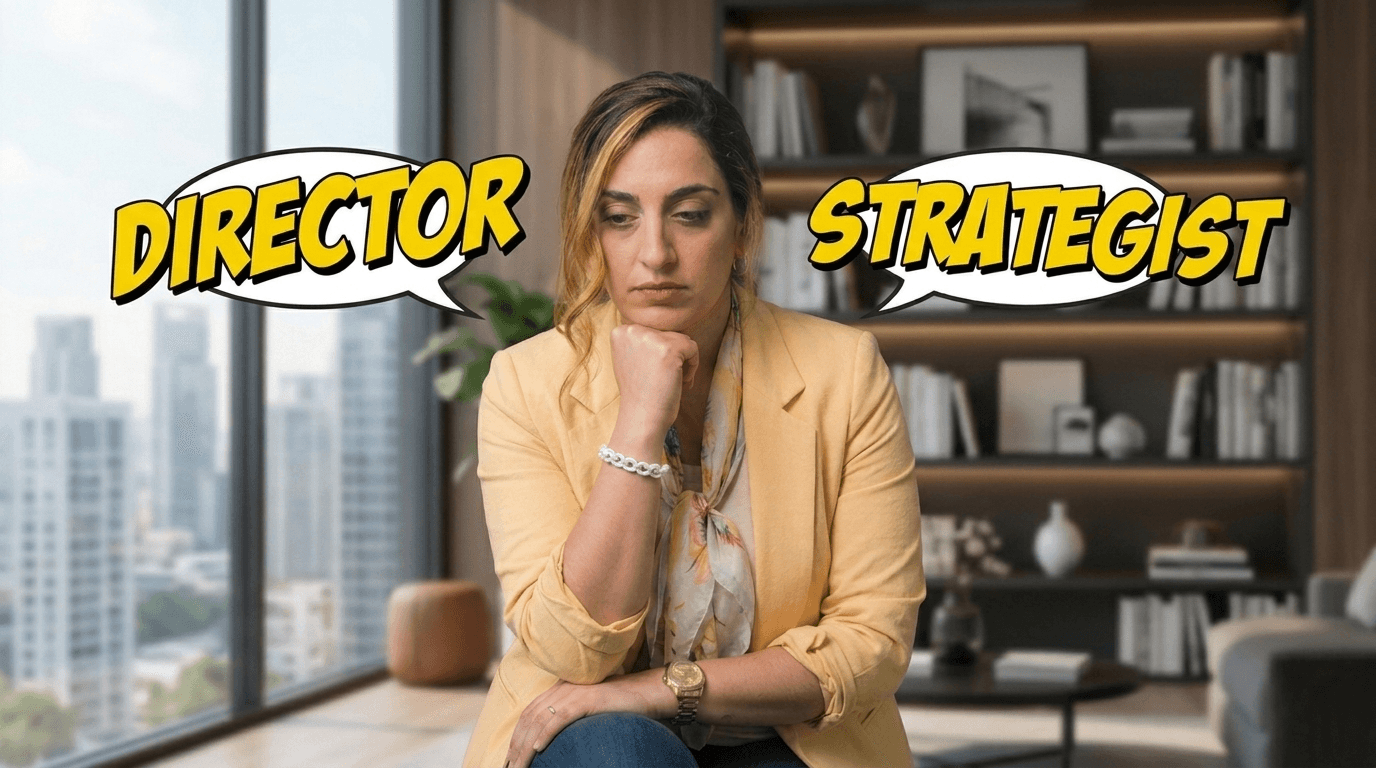
What is the difference between a creative director and a creative strategist?
A creative strategist generally focuses on the strategic thinking behind creative work, including audiences, positioning, insights, messaging and campaign strategy. A creative director turns that strategic thinking into creative vision, concepts and execution. The two roles frequently work closely together.
The Short Version
If you remember nothing else, remember this:
A creative director turns business problems into creative direction.
They decide what the work needs to accomplish.
They develop the vision.
They lead the people making it.
They challenge the ideas.
They protect the brand.
They make the decisions.
And increasingly, they figure out how humans and AI can work together without producing an endless stream of beige corporate content.
That last part may become the hardest job of all.

Join me for a coffee...
More to Discover

What Does a Creative Director Actually Do
Learn how creative directors shape strategy, lead teams, build brands and turn business goals into creative work.
Insights
People have a funny idea of what a creative director does.
They picture someone walking into a meeting, looking at a mood board and saying, “Make the logo bigger.”
That is certainly part of the mythology.
The actual job is considerably more interesting.
A creative director sets the creative vision for a brand, campaign or organization and makes sure the work supports a larger business goal. They connect strategy with creative execution, lead creative teams, make decisions, develop ideas and protect the quality of the final work.
In practical terms, a creative director is responsible for answering a deceptively difficult question:
What should we make, why should we make it and how do we make sure it matters?
“The best creative direction sits somewhere between imagination and accountability. You need enough imagination to make people care and enough accountability to make sure the work actually does something.”
Riel Bo, Creative Director
That balance is the interesting part.
A creative director isn't simply the person with the strongest opinions about fonts. Although, to be fair, there are moments when strong opinions about fonts are completely justified.
What Does a Creative Director Do?
A creative director typically oversees the creative vision, strategy, execution and quality of a project or brand.
Their responsibilities can include:
Developing creative concepts
Defining brand direction
Translating business goals into creative ideas
Leading designers, writers, photographers, developers and other creative professionals
Reviewing and improving creative work
Presenting ideas to clients and executives
Establishing visual and verbal direction
Managing creative processes
Making creative decisions
Maintaining brand consistency
Connecting creative work to marketing goals
Building creative teams and workflows
Using emerging technology such as AI to improve creative production
The exact job changes depending on the organization.
A creative director at an advertising agency may spend much of their time developing campaigns. A creative director at a technology company may focus on brand, product experiences and content. A freelance creative director might do all of the above before making dinner.
The title changes.
The fundamental responsibility stays remarkably consistent:
Give the creative work a clear direction.
The Creative Director Is the Bridge Between Strategy and Execution
This is where the role gets interesting.
Businesses tend to have goals.
Creative teams work with ideas.
A creative director connects those two worlds.
Imagine a company launching a new financial product.
The business goal might be:
Increase adoption among small business owners.
The marketing team might identify the audience and develop the positioning.
The creative director then asks:
What should this feel like?
Maybe the category is usually cold, complicated and painfully corporate. The opportunity could be to make financial technology feel human, confident and surprisingly simple.
That decision influences everything that follows.
The campaign idea.
The photography.
The typography.
The website.
The advertising.
The language.
The motion design.
The social content.
Suddenly, a creative direction exists.
That is the job.
“Creative direction is often the moment where a business problem becomes a creative opportunity. That's one of my favorite parts of the work.”
Riel Bo, Creative Director
1. Creative Directors Set the Vision
Every good creative project needs a point of view.
Without one, you get a collection of things.
A logo over here.
A website over there.
Some social graphics.
A campaign headline that someone really likes.
A presentation with 46 slides explaining the thinking behind the campaign headline.
None of these things necessarily add up to an idea.
The creative director establishes the larger vision.
That might include:
The creative concept
The visual language
The tone of voice
The emotional response
The audience experience
The brand personality
The campaign direction
The overall quality standard
The vision gives everyone something to work toward.
It also gives everyone something to reject.
That second part is important.
Creative direction isn't just deciding what belongs.
It is deciding what doesn't.
2. Creative Directors Turn Strategy Into Ideas
Strategy can tell you where you need to go.
Creative direction figures out what the journey looks like.
A strategic document might say:
We need to position the company as the easiest platform for growing businesses.
Useful.
A creative director starts asking different questions.
What does “easy” look like?
What does it sound like?
What would make someone believe it?
What could the brand do that competitors aren't doing?
What idea could communicate that benefit in two seconds?
This is where creative thinking becomes commercially useful.
A good creative director knows that an interesting idea is only the beginning.
The idea needs somewhere to go.
3. Creative Directors Lead Creative Teams
Creative directors rarely make every piece of the work themselves.
They lead the people who do.
Depending on the project, that team might include:
Art directors
Designers
Copywriters
Strategists
Developers
Photographers
Videographers
Motion designers
UX designers
Content creators
Production teams
AI specialists
The creative director creates the conditions for those people to do excellent work.
That requires more than giving instructions.
It requires knowing when to push.
Knowing when to step back.
Knowing when an idea needs another round.
Knowing when an idea has already been through enough rounds and everyone should probably go home.
4. Creative Directors Give Creative Feedback
This is one of the most important skills in the job.
And one of the easiest to underestimate.
“Make it better” is not creative direction.
Neither is:
“I don't like it.”
Useful feedback explains why something isn't working and gives the team a clearer path forward.
A creative director might say:
“The concept is strong but the execution feels too polished for the audience. We need some tension here. Right now it looks like a company trying very hard to look trustworthy. I want it to feel like a company that already is.”
That gives a designer something to work with.
Creative feedback should create clarity.
It shouldn't create emotional damage.
Although some designers will tell you there is a fine line.
5. Creative Directors Protect the Brand
A brand can be beautifully designed and still become a mess.
One campaign feels playful.
The website feels serious.
The sales deck sounds like a law firm.
The social media account suddenly starts talking like a teenager who has discovered five new slang words.
Someone needs to maintain the larger picture.
That person is often the creative director.
They protect the consistency of:
Visual identity
Brand voice
Creative concepts
Customer experience
Campaign expression
Content
Marketing materials
Consistency doesn't mean making everything look identical.
It means making everything feel like it belongs to the same organization.
6. Creative Directors Present and Sell Ideas
Creative directors need to communicate.
A brilliant idea that nobody understands is a very expensive secret.
Creative directors regularly present concepts to:
Clients
CEOs
Marketing leaders
Founders
Boards
Internal stakeholders
Creative teams
That means explaining creative work in language that makes sense to the audience in the room.
A designer might care about composition.
A CMO might care about differentiation.
A CEO might care about growth.
A customer might care about whether the product solves their problem.
The creative director needs to connect those perspectives.
“You should be able to explain a creative idea to a designer at 10 a.m. and a CFO at 2 p.m. without changing what the idea actually means.”
Riel Bo, Creative Director
That is a useful superpower.
7. Creative Directors Make Decisions
There is a lot of ambiguity in creative work.
Everyone has an opinion.
Everyone knows someone who would do it differently.
Someone's brother has a marketing degree.
Someone else once took a Photoshop class.
Eventually somebody has to decide.
Creative directors make those decisions.
They evaluate the work against the strategy, the audience, the brand and the business objective.
That requires judgment.
And judgment is one of the things that becomes more valuable as creative tools become more powerful.
Which brings us to AI.
8. AI Is Changing the Creative Director Role
Creative directors now have access to tools that can generate copy, images, video, concepts, layouts, research and variations in seconds.
That changes the production process dramatically.
It also changes the creative director's job.
When production becomes faster, direction becomes more important.
You can generate 100 ideas very quickly.
The difficult question is still:
Which one is worth pursuing?
AI can help explore possibilities.
It can help with research.
It can create variations.
It can accelerate production.
It can even challenge a creative concept.
But someone still needs to understand the brand, the audience, the business and the cultural context well enough to make the call.
“AI has made the question ‘Can we make it?’ much less interesting. The better question is ‘Should we make it?’”
Riel Bo, Creative Director
That distinction is going to shape the next generation of creative leadership.
The creative director of the future may spend less time managing individual production tasks and more time orchestrating people, technology, ideas and systems.
Creative Director vs. Art Director
These roles overlap, which is why people often confuse them.
An art director generally focuses on the visual execution of a project. They may establish the visual style, direct designers and oversee how a concept is expressed visually.
A creative director typically operates at a broader level.
They may oversee:
Creative strategy
Brand direction
Campaign concepts
Art direction
Copy direction
Creative teams
Client relationships
Production
Overall creative quality
There are plenty of organizations where the titles overlap.
Job titles are notoriously creative themselves.
The important distinction is scope.
Art direction is often concerned with how an idea looks.
Creative direction considers the idea, the reason behind it and how the entire creative system supports the larger objective.
What Skills Does a Creative Director Need?
There is no single degree or career path that turns someone into a creative director.
The role usually develops through years of creative and strategic experience.
The strongest creative directors tend to develop several overlapping skills.
Creative Thinking
You need to generate ideas.
More importantly, you need to recognize good ideas.
Those are different skills.
Strategic Thinking
Creative work needs context.
You should understand the business problem, the audience and the competitive landscape.
Communication
You need to explain ideas clearly.
You also need to listen.
That second one occasionally gets forgotten.
Leadership
Creative teams need direction, trust and accountability.
A creative director should make people better at their jobs rather than simply becoming the person everyone waits for.
Visual Literacy
You don't necessarily need to be the best designer in the room.
You do need to understand design well enough to recognize strong work and explain why something is or isn't working.
Business Understanding
Great creative work exists inside a business.
Understanding revenue, customers, positioning, marketing and growth makes creative decisions more useful.
Presentation
Ideas need champions.
Creative directors need to sell ideas internally and externally.
Curiosity
Technology changes.
Culture changes.
Audiences change.
The creative director who stops paying attention eventually becomes a creative director who talks fondly about 2007.
What Makes a Great Creative Director?
Experience matters.
Taste matters.
Strategy matters.
Leadership matters.
But I think the best creative directors have another quality:
They can make complexity feel simple.
A client might arrive with 14 competing problems.
A marketing team might have three audiences.
A brand might have six product lines.
The business might have a very long presentation explaining all of this.
The creative director's job is to find the thread.
What matters?
What is the opportunity?
What should people remember?
What should we make?
What should we leave out?
That is where creative direction becomes valuable.
“I think of creative direction as organized curiosity. You have to stay curious enough to find the interesting idea, then organized enough to turn that idea into something people can actually use.”
Riel Bo, Creative Director
The Creative Director of the Future
The creative director role is changing.
Technology is accelerating production.
AI is changing workflows.
Teams are becoming more distributed.
Brands are producing more content across more channels.
Customers are becoming harder to impress and easier to overwhelm.
That creates an interesting problem.
There has never been a greater ability to make things.
There has also never been a greater need for someone to decide what deserves to be made.
That is where creative direction comes in.
The modern creative director isn't simply managing designers or approving campaigns.
They are building the conditions for good ideas to happen.
They connect business strategy with human insight.
They connect technology with creativity.
They turn complexity into direction.
And ideally, they keep the meeting moving.
Because somebody has to.
Frequently Asked Questions
What does a creative director do?
A creative director develops and oversees the creative vision for a brand, campaign or organization. They connect business strategy with creative execution, lead creative teams, develop concepts, review work and maintain the overall quality and direction of the creative output.
What is the difference between a creative director and an art director?
An art director generally focuses on the visual execution of creative work. A creative director usually has broader responsibility for the overall creative vision, strategy, concepts, brand expression and team direction.
What skills does a creative director need?
Important creative director skills include creative thinking, strategic thinking, communication, leadership, presentation, visual literacy, business understanding and strong creative judgment.
Do creative directors need to be designers?
No. Many creative directors have design backgrounds, but creative direction is broader than design. A creative director needs enough visual understanding to evaluate and direct creative work while also understanding strategy, business, audiences and communication.
Is creative direction a good career?
Creative direction can be a rewarding career for people who enjoy ideas, leadership, problem-solving and communication. The role offers opportunities to influence brands, campaigns, teams and business decisions.
How is AI changing creative direction?
AI is accelerating many creative production tasks including research, ideation, writing, image generation and content development. This increases the importance of creative judgment, strategy, brand understanding and the ability to direct AI-assisted workflows.
What is the difference between a creative director and a creative strategist?
A creative strategist generally focuses on the strategic thinking behind creative work, including audiences, positioning, insights, messaging and campaign strategy. A creative director turns that strategic thinking into creative vision, concepts and execution. The two roles frequently work closely together.
The Short Version
If you remember nothing else, remember this:
A creative director turns business problems into creative direction.
They decide what the work needs to accomplish.
They develop the vision.
They lead the people making it.
They challenge the ideas.
They protect the brand.
They make the decisions.
And increasingly, they figure out how humans and AI can work together without producing an endless stream of beige corporate content.
That last part may become the hardest job of all.
Join me for a coffee...
More to Discover
What Does a Creative Director Actually Do
Learn how creative directors shape strategy, lead teams, build brands and turn business goals into creative work.
Insights
People have a funny idea of what a creative director does.
They picture someone walking into a meeting, looking at a mood board and saying, “Make the logo bigger.”
That is certainly part of the mythology.
The actual job is considerably more interesting.
A creative director sets the creative vision for a brand, campaign or organization and makes sure the work supports a larger business goal. They connect strategy with creative execution, lead creative teams, make decisions, develop ideas and protect the quality of the final work.
In practical terms, a creative director is responsible for answering a deceptively difficult question:
What should we make, why should we make it and how do we make sure it matters?
“The best creative direction sits somewhere between imagination and accountability. You need enough imagination to make people care and enough accountability to make sure the work actually does something.”
Riel Bo, Creative Director
That balance is the interesting part.
A creative director isn't simply the person with the strongest opinions about fonts. Although, to be fair, there are moments when strong opinions about fonts are completely justified.
What Does a Creative Director Do?
A creative director typically oversees the creative vision, strategy, execution and quality of a project or brand.
Their responsibilities can include:
Developing creative concepts
Defining brand direction
Translating business goals into creative ideas
Leading designers, writers, photographers, developers and other creative professionals
Reviewing and improving creative work
Presenting ideas to clients and executives
Establishing visual and verbal direction
Managing creative processes
Making creative decisions
Maintaining brand consistency
Connecting creative work to marketing goals
Building creative teams and workflows
Using emerging technology such as AI to improve creative production
The exact job changes depending on the organization.
A creative director at an advertising agency may spend much of their time developing campaigns. A creative director at a technology company may focus on brand, product experiences and content. A freelance creative director might do all of the above before making dinner.
The title changes.
The fundamental responsibility stays remarkably consistent:
Give the creative work a clear direction.
The Creative Director Is the Bridge Between Strategy and Execution
This is where the role gets interesting.
Businesses tend to have goals.
Creative teams work with ideas.
A creative director connects those two worlds.
Imagine a company launching a new financial product.
The business goal might be:
Increase adoption among small business owners.
The marketing team might identify the audience and develop the positioning.
The creative director then asks:
What should this feel like?
Maybe the category is usually cold, complicated and painfully corporate. The opportunity could be to make financial technology feel human, confident and surprisingly simple.
That decision influences everything that follows.
The campaign idea.
The photography.
The typography.
The website.
The advertising.
The language.
The motion design.
The social content.
Suddenly, a creative direction exists.
That is the job.
“Creative direction is often the moment where a business problem becomes a creative opportunity. That's one of my favorite parts of the work.”
Riel Bo, Creative Director
1. Creative Directors Set the Vision
Every good creative project needs a point of view.
Without one, you get a collection of things.
A logo over here.
A website over there.
Some social graphics.
A campaign headline that someone really likes.
A presentation with 46 slides explaining the thinking behind the campaign headline.
None of these things necessarily add up to an idea.
The creative director establishes the larger vision.
That might include:
The creative concept
The visual language
The tone of voice
The emotional response
The audience experience
The brand personality
The campaign direction
The overall quality standard
The vision gives everyone something to work toward.
It also gives everyone something to reject.
That second part is important.
Creative direction isn't just deciding what belongs.
It is deciding what doesn't.
2. Creative Directors Turn Strategy Into Ideas
Strategy can tell you where you need to go.
Creative direction figures out what the journey looks like.
A strategic document might say:
We need to position the company as the easiest platform for growing businesses.
Useful.
A creative director starts asking different questions.
What does “easy” look like?
What does it sound like?
What would make someone believe it?
What could the brand do that competitors aren't doing?
What idea could communicate that benefit in two seconds?
This is where creative thinking becomes commercially useful.
A good creative director knows that an interesting idea is only the beginning.
The idea needs somewhere to go.
3. Creative Directors Lead Creative Teams
Creative directors rarely make every piece of the work themselves.
They lead the people who do.
Depending on the project, that team might include:
Art directors
Designers
Copywriters
Strategists
Developers
Photographers
Videographers
Motion designers
UX designers
Content creators
Production teams
AI specialists
The creative director creates the conditions for those people to do excellent work.
That requires more than giving instructions.
It requires knowing when to push.
Knowing when to step back.
Knowing when an idea needs another round.
Knowing when an idea has already been through enough rounds and everyone should probably go home.
4. Creative Directors Give Creative Feedback
This is one of the most important skills in the job.
And one of the easiest to underestimate.
“Make it better” is not creative direction.
Neither is:
“I don't like it.”
Useful feedback explains why something isn't working and gives the team a clearer path forward.
A creative director might say:
“The concept is strong but the execution feels too polished for the audience. We need some tension here. Right now it looks like a company trying very hard to look trustworthy. I want it to feel like a company that already is.”
That gives a designer something to work with.
Creative feedback should create clarity.
It shouldn't create emotional damage.
Although some designers will tell you there is a fine line.
5. Creative Directors Protect the Brand
A brand can be beautifully designed and still become a mess.
One campaign feels playful.
The website feels serious.
The sales deck sounds like a law firm.
The social media account suddenly starts talking like a teenager who has discovered five new slang words.
Someone needs to maintain the larger picture.
That person is often the creative director.
They protect the consistency of:
Visual identity
Brand voice
Creative concepts
Customer experience
Campaign expression
Content
Marketing materials
Consistency doesn't mean making everything look identical.
It means making everything feel like it belongs to the same organization.
6. Creative Directors Present and Sell Ideas
Creative directors need to communicate.
A brilliant idea that nobody understands is a very expensive secret.
Creative directors regularly present concepts to:
Clients
CEOs
Marketing leaders
Founders
Boards
Internal stakeholders
Creative teams
That means explaining creative work in language that makes sense to the audience in the room.
A designer might care about composition.
A CMO might care about differentiation.
A CEO might care about growth.
A customer might care about whether the product solves their problem.
The creative director needs to connect those perspectives.
“You should be able to explain a creative idea to a designer at 10 a.m. and a CFO at 2 p.m. without changing what the idea actually means.”
Riel Bo, Creative Director
That is a useful superpower.
7. Creative Directors Make Decisions
There is a lot of ambiguity in creative work.
Everyone has an opinion.
Everyone knows someone who would do it differently.
Someone's brother has a marketing degree.
Someone else once took a Photoshop class.
Eventually somebody has to decide.
Creative directors make those decisions.
They evaluate the work against the strategy, the audience, the brand and the business objective.
That requires judgment.
And judgment is one of the things that becomes more valuable as creative tools become more powerful.
Which brings us to AI.
8. AI Is Changing the Creative Director Role
Creative directors now have access to tools that can generate copy, images, video, concepts, layouts, research and variations in seconds.
That changes the production process dramatically.
It also changes the creative director's job.
When production becomes faster, direction becomes more important.
You can generate 100 ideas very quickly.
The difficult question is still:
Which one is worth pursuing?
AI can help explore possibilities.
It can help with research.
It can create variations.
It can accelerate production.
It can even challenge a creative concept.
But someone still needs to understand the brand, the audience, the business and the cultural context well enough to make the call.
“AI has made the question ‘Can we make it?’ much less interesting. The better question is ‘Should we make it?’”
Riel Bo, Creative Director
That distinction is going to shape the next generation of creative leadership.
The creative director of the future may spend less time managing individual production tasks and more time orchestrating people, technology, ideas and systems.
Creative Director vs. Art Director
These roles overlap, which is why people often confuse them.
An art director generally focuses on the visual execution of a project. They may establish the visual style, direct designers and oversee how a concept is expressed visually.
A creative director typically operates at a broader level.
They may oversee:
Creative strategy
Brand direction
Campaign concepts
Art direction
Copy direction
Creative teams
Client relationships
Production
Overall creative quality
There are plenty of organizations where the titles overlap.
Job titles are notoriously creative themselves.
The important distinction is scope.
Art direction is often concerned with how an idea looks.
Creative direction considers the idea, the reason behind it and how the entire creative system supports the larger objective.
What Skills Does a Creative Director Need?
There is no single degree or career path that turns someone into a creative director.
The role usually develops through years of creative and strategic experience.
The strongest creative directors tend to develop several overlapping skills.
Creative Thinking
You need to generate ideas.
More importantly, you need to recognize good ideas.
Those are different skills.
Strategic Thinking
Creative work needs context.
You should understand the business problem, the audience and the competitive landscape.
Communication
You need to explain ideas clearly.
You also need to listen.
That second one occasionally gets forgotten.
Leadership
Creative teams need direction, trust and accountability.
A creative director should make people better at their jobs rather than simply becoming the person everyone waits for.
Visual Literacy
You don't necessarily need to be the best designer in the room.
You do need to understand design well enough to recognize strong work and explain why something is or isn't working.
Business Understanding
Great creative work exists inside a business.
Understanding revenue, customers, positioning, marketing and growth makes creative decisions more useful.
Presentation
Ideas need champions.
Creative directors need to sell ideas internally and externally.
Curiosity
Technology changes.
Culture changes.
Audiences change.
The creative director who stops paying attention eventually becomes a creative director who talks fondly about 2007.
What Makes a Great Creative Director?
Experience matters.
Taste matters.
Strategy matters.
Leadership matters.
But I think the best creative directors have another quality:
They can make complexity feel simple.
A client might arrive with 14 competing problems.
A marketing team might have three audiences.
A brand might have six product lines.
The business might have a very long presentation explaining all of this.
The creative director's job is to find the thread.
What matters?
What is the opportunity?
What should people remember?
What should we make?
What should we leave out?
That is where creative direction becomes valuable.
“I think of creative direction as organized curiosity. You have to stay curious enough to find the interesting idea, then organized enough to turn that idea into something people can actually use.”
Riel Bo, Creative Director
The Creative Director of the Future
The creative director role is changing.
Technology is accelerating production.
AI is changing workflows.
Teams are becoming more distributed.
Brands are producing more content across more channels.
Customers are becoming harder to impress and easier to overwhelm.
That creates an interesting problem.
There has never been a greater ability to make things.
There has also never been a greater need for someone to decide what deserves to be made.
That is where creative direction comes in.
The modern creative director isn't simply managing designers or approving campaigns.
They are building the conditions for good ideas to happen.
They connect business strategy with human insight.
They connect technology with creativity.
They turn complexity into direction.
And ideally, they keep the meeting moving.
Because somebody has to.
Frequently Asked Questions
What does a creative director do?
A creative director develops and oversees the creative vision for a brand, campaign or organization. They connect business strategy with creative execution, lead creative teams, develop concepts, review work and maintain the overall quality and direction of the creative output.
What is the difference between a creative director and an art director?
An art director generally focuses on the visual execution of creative work. A creative director usually has broader responsibility for the overall creative vision, strategy, concepts, brand expression and team direction.
What skills does a creative director need?
Important creative director skills include creative thinking, strategic thinking, communication, leadership, presentation, visual literacy, business understanding and strong creative judgment.
Do creative directors need to be designers?
No. Many creative directors have design backgrounds, but creative direction is broader than design. A creative director needs enough visual understanding to evaluate and direct creative work while also understanding strategy, business, audiences and communication.
Is creative direction a good career?
Creative direction can be a rewarding career for people who enjoy ideas, leadership, problem-solving and communication. The role offers opportunities to influence brands, campaigns, teams and business decisions.
How is AI changing creative direction?
AI is accelerating many creative production tasks including research, ideation, writing, image generation and content development. This increases the importance of creative judgment, strategy, brand understanding and the ability to direct AI-assisted workflows.
What is the difference between a creative director and a creative strategist?
A creative strategist generally focuses on the strategic thinking behind creative work, including audiences, positioning, insights, messaging and campaign strategy. A creative director turns that strategic thinking into creative vision, concepts and execution. The two roles frequently work closely together.
The Short Version
If you remember nothing else, remember this:
A creative director turns business problems into creative direction.
They decide what the work needs to accomplish.
They develop the vision.
They lead the people making it.
They challenge the ideas.
They protect the brand.
They make the decisions.
And increasingly, they figure out how humans and AI can work together without producing an endless stream of beige corporate content.
That last part may become the hardest job of all.